

The Lede
Big Tech earnings rewrote the playbook last week, and we got two of them wrong the same way. We called Microsoft and Amazon for the "sell the news" pattern that has held for eight straight quarters — but Azure printed +40% YoY (vs the Street's 37%), AWS hit a 15-quarter high at +28%, and the market shrugged off Microsoft's $190B capex guide and Amazon's $200B. The pattern broke.
What didn't break: the bifurcation between Google (+10% on a clean cloud beat) and Meta (-6% on a $115-135B capex revision). Combined Big Tech AI capex now exceeds $600B for 2026, and investors have stopped clapping for the announcement. They're grading the return. Issue #2 walks through the misses, the regime change, and the trade that's setting up for the rest of the year.
The Pulse
|
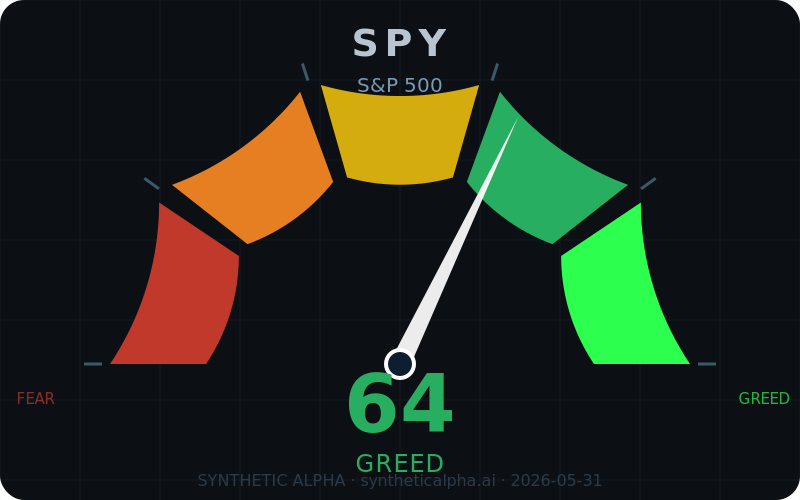
S&P 500 🟨 Neutral Recovered the April drawdown on below-average volume — bullish MA stack intact but the $738 swing high hasn't fallen and the May 7 FOMC is binary. |
|
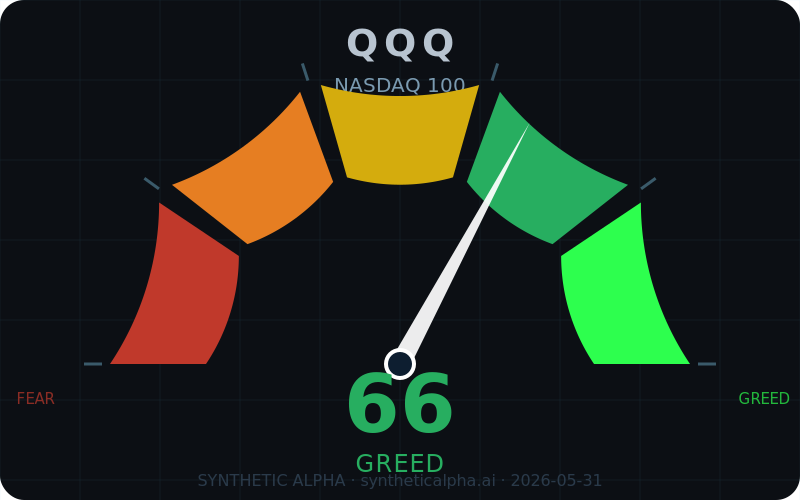
NASDAQ 🟩 Greed Bull flag breakout pointing $695–$702 — the catch is a 28–32x P/E and weak breakout volume; buy pullbacks to $655–$668, don't chase. |
|
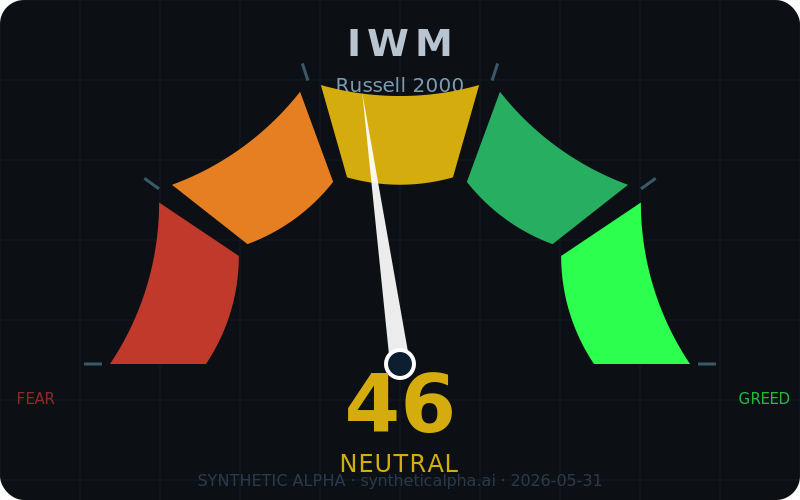
Russell 2000 🟨 Neutral Relief rally inside a primary downtrend, still trading under the 200-day MA — May 7 FOMC flips it dovish or accelerates the bear. |
|
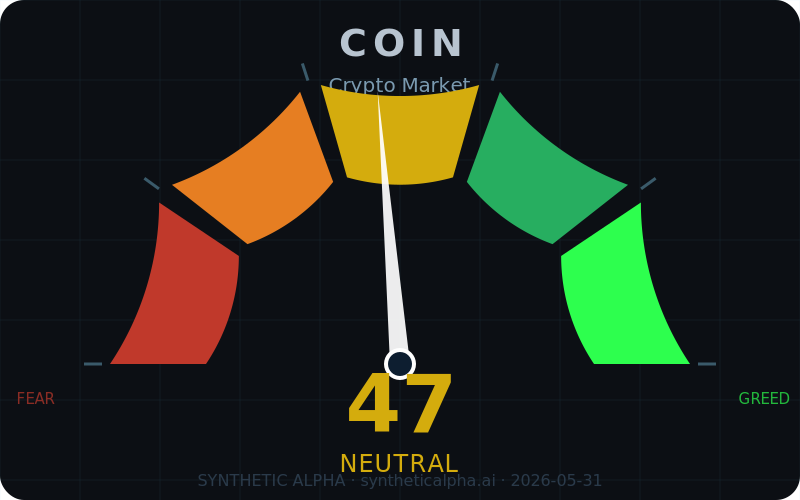
Crypto 🟨 Neutral Coinbase sits 57% off highs with a bearish MA stack post-Q1 miss; no confirmed reversal until $205 reclaim on volume. |
Deep Dive - DeFi held the line
April was the worst month on record for DeFi exploits. According to DeFiLlama, $635 million was drained across 25+ separate incidents — Kelp DAO ($293M on April 19), Drift Protocol ($285M earlier in April), and a daily run of smaller hits since April 25. The throughline: agentic AI systems autonomously scanning smart contracts at machine speed, generating exploit code without human input. North Korea-linked actors got attribution for the two largest. This is the offensive side of the AI-in-finance story, and the numbers got worse, not better.
The non-obvious read came on April 29, when Standard Chartered published a research note arguing DeFi infrastructure absorbed the shock. AAVE-led liquidity backstops steadied affected markets within days. Total Value Locked dipped, but the cascading collapse the doom narrative kept predicting didn't materialize. The protocols held.
How does protocol-level resilience actually work? Three things, in plain language. First, most production DeFi protocols are now over-collateralized — even when an exploit drains a vault, the rest of the system has more locked value than the loss, so the platform stays solvent. Second, governance tokens like AAVE function as a backstop: in a crisis, the protocol can mint and sell tokens to cover bad debt, the same way a central bank prints to recapitalize. Third, exploit insurance markets (Nexus Mutual, Sherlock) now provide rapid payouts that keep liquid markets making.
What this means: the "DeFi is fundamentally broken" thesis has a shrinking shelf life. April was the stress test, and the stress test passed. The next 90 days will tell us whether agentic AI offense scales faster than protocol defense — but the first round, by Standard Chartered's read, went to defense. Watch the AAVE/TVL ratio (insurance coverage as a percentage of locked value) as the live indicator. If it stays above 8%, the resilience thesis holds. Below 5%, we revisit.
Alpha Feed
CFTC AI will gate U.S. crypto registration applications** — CoinDesk
The CFTC chairman told CoinDesk on April 27 that the agency is building AI tools to review and reject incomplete crypto registration applications. Pair with FinCEN's April 7 NPRM signaling AI as a marker of compliance-program maturity, and you have two regulators saying the same thing the same week: AI is now both the ground-truth standard for compliance AND the gatekeeper at the door.The capex bifurcation became market-moving** — Fortune | CNBC
Microsoft and Meta got punished for AI capex prints; Google got rewarded. Same week, OpenAI reportedly missed its own user-growth and revenue projections, dragging Oracle, Broadcom, and AMD down 3-4%. The "AI capex vs AI revenue" gap is no longer a thought-piece thesis. It's pricing into stocks.The agentic-AI quant debate is now in public** — Hedgeweek (Man Group) | Hedgeweek (Aspect)
Man Numeric (Man Group's quant arm) deployed an agentic AI system that autonomously generates, codes, and backtests strategies. The same week, Aspect Capital's Martin Lueck — one of the architects of systematic trading at AHL — warned that handing investment decisions entirely to AI undermines transparency and risk management. The two camps of systematic investing arguing in public is rare. Worth listening.
The Position
The bifurcation is the trade for the rest of 2026.
Google up 10% on a clean cloud beat. Microsoft and Meta down on capex revisions even though Azure and Reality Labs both delivered. Amazon down despite a 15-quarter high in AWS growth. The market has made a decision and it's not subtle: announcing capex is not enough. You have to show the revenue catching up.
That's the regime change. For eight quarters, "AI spend" was a multiple-expander. Now it's a multiple-compressor unless the cloud number does the talking. Google has the cleanest stack — cloud accelerating into the capex, search holding, ad rev growing. Meta is in the danger zone: Reality Labs burned $4.4B this quarter, and the capex revision raised the question every prior quarter buried.
The trade isn't to short the losers. It's to recognize the spread is widening and stop treating Big Tech as one trade. Long the names with proven cloud re-acceleration. Hedge or rotate out of the names where the capex is bigger than the visible revenue path. We got Microsoft wrong this earnings cycle. We're not going to get it wrong twice.
Stay safe, build safe, trade safe.
On The Radar - x402
x402 is the protocol that lets AI agents pay other AI agents in stablecoins, automatically, over HTTP. Coinbase incubated it; Stripe, Cloudflare, AWS, Google, and the Solana Foundation back the standard. As of April 21, 69,000 active agents had processed 165 million transactions worth $50 million.
The big news this week: Dexter quietly flipped Coinbase as the top transaction facilitator, and four separate facilitators now each process 10M+ transactions — meaning the rails are no longer one company's. The concentration tension is one layer up: Base chain handles 68M transactions versus all other chains combined, and USDC is 98.7% of the value moving across. Watch whether autonomous-agent commerce stays this concentrated as it scales — or whether the multi-facilitator pattern of this week becomes the multi-chain pattern of next quarter.
Either way, this is the rail AI agents will run on. Knowing who controls it matters.
Synthetic Alpha publishes every Monday at 6am Eastern.
Forward this to someone who needs to know what's actually happening in AI and finance.