

The Lede
This week, anti-money-laundering investigators at two American banks got a colleague that doesn't sleep.
BMO and Amalgamated Bank are the first institutions piloting a Financial Crimes AI Agent built by FIS and Anthropic. The product, announced on May 4, is the first deliverable from a partnership FIS is calling "agent-first banking" — and it targets one of the most expensive manual workflows in compliance.
AML investigations are slow because the work is. An analyst pulls transaction records, cross-references customer profiles, walks the activity against known typologies, and writes it up. Sometimes over days. Often for a case that turns out to be noise. The new agent does the assembly: when a case opens, it builds the evidence pack from across the bank's core systems, scores it against known patterns, and hands the analyst a ranked queue with the reasoning attached. The hours-to-minutes claim is the use case the partnership chose to lead with because it's the easiest one to defend with an audit trail.
Amalgamated — the New York bank with deep roots in the labor-union and progressive-cause world — is more than a customer; its compliance team is inside the build. "This pilot partnership supports development of agentic AI capabilities to optimize anti-money-laundering investigations," said Priscilla Sims Brown, the bank's CEO. BMO is running a parallel deployment. Anthropic's forward-deployed engineers are embedded with FIS, Claude's reasoning runs inside FIS-controlled infrastructure, and every agent action is traceable. Human investigators keep the final call.
Banks spend tens of billions a year on AML, most of it chasing alerts that go nowhere. Tackling that pile first is the obvious play. The roadmap is what's worth watching — credit decisioning, deposit retention, customer onboarding, fraud prevention. Each is a workflow where regulated finance has historically refused to hand the steering wheel to a model. FIS now plans to ship an agent into all of them, with broader availability slated for the second half of 2026.
The story this week isn't that AI showed up in finance. It's which layer of the stack captures the value when it scales.
The Pulse
|
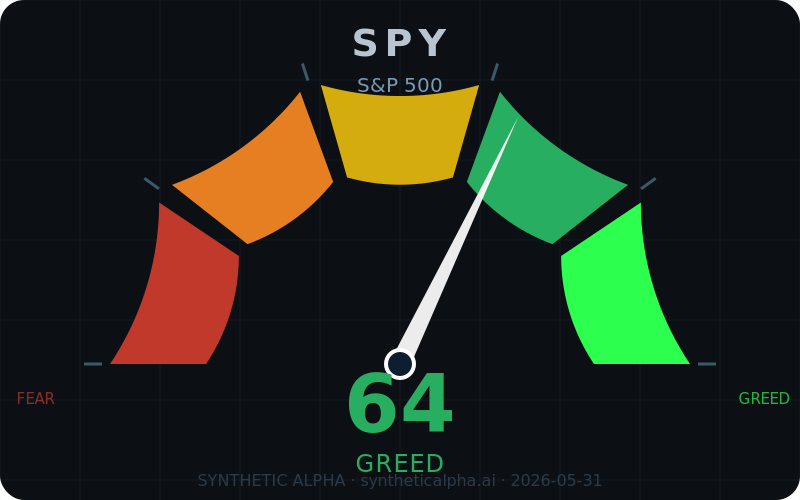
S&P 500 🟩 Greed Reclaimed $737 in a clean bullish MA stack — but 47M-share volume vs. the 75M norm flags a low-conviction breakout, and mid-May U.S.–China trade-talks are the binary. |
|
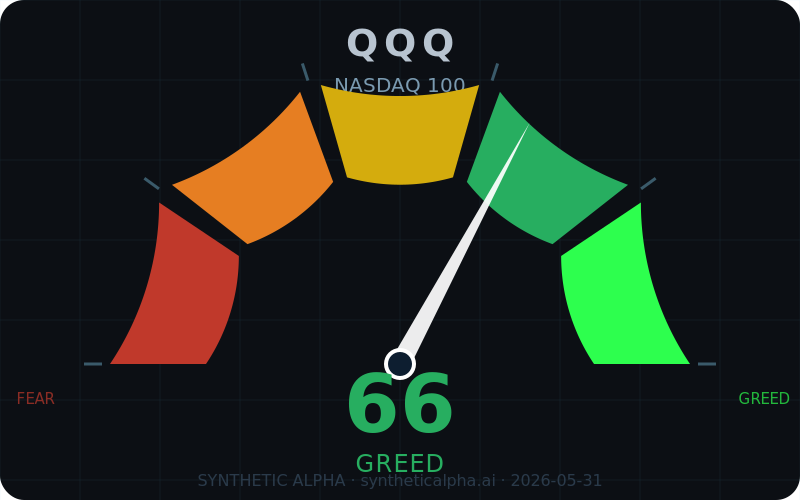
NASDAQ 🟩 Greed +2.34% to $711 on an Inverse H&S resolving — but record options volume says institutions are buying protection alongside upside; wait the $700–$708 retest before adding. |
|
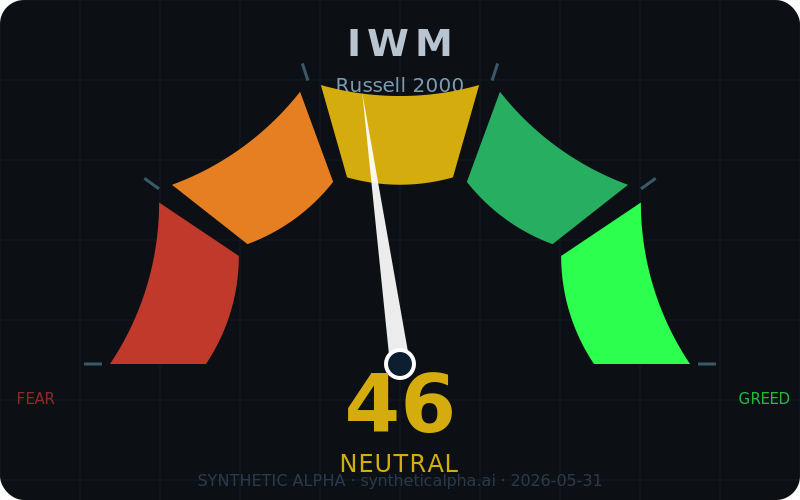
Russell 2000 🟨 Neutral Healing chart inside a still-bearish weekly structure — above the 20/50-day, but the $291–$295 cluster (200-day MA + iH&S neckline) is the line; the May FOMC tone makes or breaks the rate-cut thesis underneath the trade. |
|
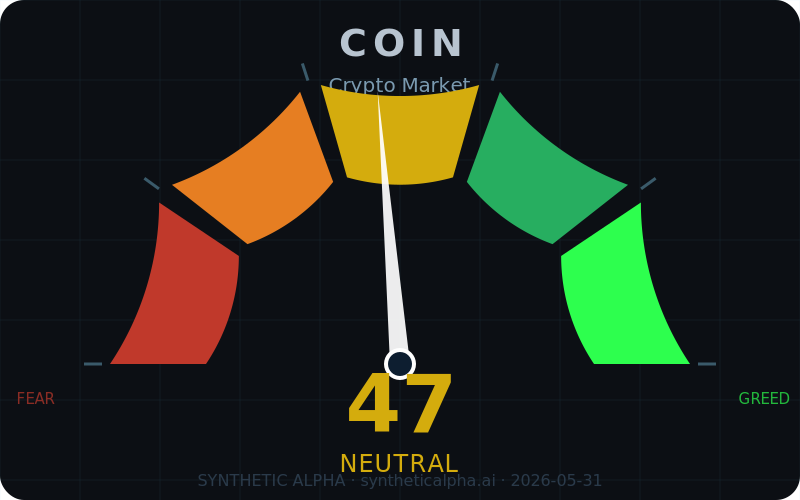
Crypto 🟨 Neutral +4.25% to $201 on real volume after the SEC withdrawal and a Q1 beat — but $205–$215 (50-day SMA) is make-or-break; fail and it retests $165, with early-August Q2 earnings the next ±20–30% binary. |
Deep Dive - Anthropic shipped a Palantir
The headline is the AML agent. The structurally interesting move is the deal shape.
Anthropic's "Applied AI" team and forward-deployed engineers are embedded with FIS to co-build the Financial Crimes AI Agent — and to teach FIS how to ship subsequent agents on its own. Anthropic's own press materials are explicit: knowledge transfer so FIS can build and scale additional agents independently. That sentence is the whole story. It's not a software license. It's an enterprise-services engagement that happens to ship code.
This is Palantir's go-to-market motion, ported to LLMs.
Palantir built a $320 billion market cap by sending forward-deployed engineers into regulated buyers — banks, defense, intelligence — to co-build vertical software inside the customer's compliance perimeter. The work transfers as enterprise IP, not as a SaaS subscription, and customers pay for the team as much as the product. Anthropic appears to be running the same play at a scale OpenAI doesn't yet match: API access for everyone, but FDE-driven enterprise builds for the specific customers whose use cases are too regulated, too data-heavy, and too workflow-specific for self-serve.
The AML use case is well chosen. AML investigations are slow because the work is — assembling evidence from siloed core systems, scoring against typologies, writing a defensible SAR — and that work has audit trail baked into its DNA. It is the easiest agentic deployment to defend to a regulator: every action logged, every decision traceable, every output reviewable by a human who keeps the call. The published roadmap (credit decisioning, deposit retention, onboarding, fraud) is everything else regulated banking spends its compliance budget on. None of those workflows are obvious next-products. All of them are obvious next-FDE-engagements.
What to watch: how many additional Anthropic + enterprise FDE deals announce in H2 2026. One is a partnership. Three is a strategy. Five is the new shape of the LLM-vendor business model — and a structural moat that doesn't show up in the API price comparison sheet.
Alpha Feed
DeFi goes mainstream through agent-mediated UX, Consensus panel argues — CoinDesk
At Consensus Miami on May 7, Bitwise CEO Hunter Horsley and other panelists framed the next phase of DeFi adoption as agent-mediated — natural-language intents and plain-English transaction explanations ("you are about to swap 0.5 ETH for ~1,240 USDC; network fee ~$3.50") replacing the raw-hash UX that has kept retail out of DeFi for a decade. Same thesis as the FIS deal, opposite stack. TradFi captures the agent layer through regulated middleware; DeFi captures it through L1 rails and intent-based wallets. The question is no longer whether agents become the front door of finance — it's who owns the door in each stack.Orbs ships a DeFi interface designed for AI agents, not humans — The Defiant
Orbs' SPOT, launched May 1, is a DeFi trading interface composed of hosted markdown files instead of a GUI — agents read the markdown, parse the parameters, and execute gasless TWAP, limit, stop-loss, and take-profit swaps across 25+ DEXs without an API or middleware. This is interface-as-machine-readable-spec rather than "chatbot strapped to a web app." If the design pattern generalizes, the DeFi frontend stack as we currently know it stops being a competitive surface — and the value migrates to whichever protocol's spec the agents prefer to read.Visa goes global with agentic-payments program — and it integrates Anthropic — Visa Investor Relations
Visa expanded its Intelligent Commerce framework globally this week, issuing scoped tokenized credentials directly to AI agents and authenticating machine-initiated payments — with explicit integrations to Anthropic, OpenAI, and Microsoft LLMs. Mastercard is running the same play with Agent Pay (Australia, Korea, ASEAN). Both are racing to own the trust/identity layer for autonomous-agent commerce, which is to say: when an agent transacts on your behalf, somebody has to vouch it's allowed to. The card networks just made the case that "somebody" is them — not the LLM, not the merchant, not the chain.
The Position
The agent layer is real. The value capture is somewhere else.
The pitch-bros are saying "AI is winning finance" and buying the LLM names. Watch where the margin actually lands. Anthropic ships an agent into a bank — but the bank pays FIS, FIS owns the customer relationship, and Anthropic earns a usage tier plus a forward-deployed engagement that locks in the next deal. Visa issues the credentials when the agent transacts; Mastercard is fighting Visa for that lane; Solana is fighting Ethereum for the equivalent lane on the crypto side. Card networks and L1s are racing each other to become the trust/identity layer between an autonomous agent and money that moves.
The model isn't the moat. The position between the model and the regulated entity is.
That's why "agent-first banking" reads more like a Palantir deal than a SaaS launch — and why the most-valuable AI finance company of the next cycle may be the one nobody is calling an AI company. Watch the middleware names: FIS, Fiserv, nCino on bank-tech; Visa and Mastercard on the rails; Coinbase, Solana, Ethereum on the crypto side. The LLM pricing wars get the headlines. The FDE deals quietly become the picks-and-shovels.
We're not buying Anthropic. We're watching who Anthropic ships through.
Stay safe, build safe, trade safe.
On The Radar - Anthropic's forward-deployed engineer motion
A forward-deployed engineer (FDE) is the consultant-grade engineer model Palantir built its business on: instead of selling software, you embed your own engineers inside the customer's environment to co-build vertical applications, transfer knowledge, and earn the next deal. Anthropic's Applied AI team and FDEs are now embedded with FIS to ship the Financial Crimes AI Agent — and explicitly to teach FIS how to ship subsequent agents on its own.
That contract structure is what separates this from a SaaS deal. How many other Anthropic FDE engagements are live or in pilot isn't yet public — but the deal-shape now is.
What to watch: enterprise (and government) FDE deal announcements through H2 2026. Each new deal in that shape updates the priors; one was the announcement, three settles the case. The lowest-friction proxy is the named-accounts list on Anthropic's enterprise reference page — track it weekly.
Synthetic Alpha publishes every Monday at 6am Eastern.
Forward this to someone who needs to know what's actually happening in AI and finance.